|
buy this title

4K Blu-ray |
Comparison between the 4K Blu-ray (2025) and the Blu-ray from Warner (2010)
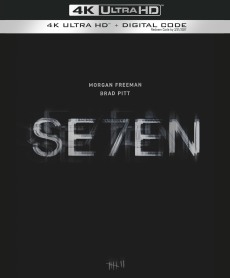
David Fincher's SE7EN with digital retouches in 4KWith Se7en, David Fincher created a genre-defining thriller in 1995 that not only provided the blueprint for the Saw series, but also works surprisingly well even now, 30 years later. After gaining initial experience working for George Lucas and Steven Spielberg in the 80s, and then having a sobering experience with Alien³, Fincher was keen to pursue his own vision here. For example, he also pushed through the dark original ending with the studio bosses. With the aesthetics, musical background and cleverly staged story, the up-and-coming director had found his signature style. The skillful editing was also part of this, and with a shot of Gwyneth Paltrow (from an earlier scene) briefly inserted for a few frames during the final scene, it also gave rise to the infamous “what's in the box” speculation among film fans, who fell into the misconception that they had originally seen something more explicit in the cinema.  Attentive fans had already noticed earlier that Criterion's very first laserdisc had minor color adjustments, and over the years, strikingly different color gradings were visible on DVDs and international Blu-rays in this regard. In fact, however, it is almost impossible to conclusively prove which release really does justice to the original CCE (Color Contrast Enhancement) process described in the linked article and the corresponding photochemical look. Especially since Fincher himself expressed a general interest in reworking the home theater versions of his films as early as the late 1990s. He is, after all, a restless perfectionist. Accordingly, he apparently also strives for maximum control over the preparation of his films for newer media. In June 2023, Fincher confirmed an elaborate 4K remastering of Seven, mentioning “a lot of shit that needs to be fixed” and “blown-out windows that we have to kind of go back and ghost in a little bit of cityscape out there”. At the same time, however, he expressed he is opposed to fundamental changes to the film itself, mockingly referring to the much-criticized change from weapons to walkie-talkies in E.T.. However, it was only in January 2025, around the time of the worldwide theatrical re-release of the new 4K restoration and the home theater premiere, that Fincher confirmed the use of artificial intelligence. He enthusiastically mentioned a moment during the conversation in the bar where there was an unwanted camera movement in the best take that had always bothered him and could now be covered up using AI-generated backgrounds from surrounding scenes. In further interviews, he gradually revealed further small adjustments. In Variety Fincher referenced a white background on the set that was now visible with the higher resolution, instead of the cityscape behind the windows that was actually desired. Apparently, a replacement for this has also been found. In Entertainment Weekly he mentioned blurred shots (now thanks to AI no longer) and at the same time emphasized that otherwise nothing else had been done and that they had simply based their work on the first CCE print. On Indiewire, Fincher commented on the now eradicated inconsistencies from various camera sources, as well as incomplete matte paintings at the time, an idiosyncratic strand of Gwyneth Patrow's hair, and again camera movements or “bumps” removed with AI. But apparently that was just the tip of the iceberg, as was then proven by uncompressed comparison images in the Blu-ray.com forum. The user ko8ebryant24 did an incredible job of detective work in the linked post, as well as in a few others. It was finally clear that we also had to take a closer look at this new version.
Spacey double & arm retouched, a bloody headshot and much more.The most important thing first: the interventions are nowhere near as drastic as in the original trilogy, and the use of AI is not as creepy as in James Cameron's classics, which the maestro personally ruined. Fincher didn't just upscale a 2K source, but scanned Seven in 8K and apparently checked it meticulously shot by shot. From the interviews just mentioned, it also became clear that he placed particular emphasis on making inconspicuous changes to the details when watching “normally”. We want to emphasize at this point that this report does not claim to be complete, because it is in the nature of these differences that much of it is simply not supposed to be noticed. In the following, we have tried to categorize the interventions in a meaningful way and thus make it as easy as possible to grasp the intention with which the work was generally approached. Disclaimer: As with most reports, spoilers are unavoidable here. Since a particularly large number of changes were made for the finale, the ending of the film will be described relatively openly below.  1. Goofs or corrected film errors / most noticeable changesFor many, the most understandable thing is the elimination of technical deficits, which a large proportion of the audience will never have noticed, but which are obvious once you know about them. More rain: Let's start with a weird one, but it illustrates quite well what kind of detail was paid attention to here. If you look closely, you'll notice that in a shot with heavy rainfall, the rain is virtually missing on the right side of the picture. Water machines were obviously used on the set but apparently not for the entire visible area. That's why the rain was “completed” on the right side of the picture. It was similarly weird during the car chase when, curiously, the rain was forgotten in a stylish shot of the approaching John Doe. Now this has been artificially reintroduced. Victor's second left arm: The victim of sloth lies half-decayed in bed and it is quite obvious that the effects artists were allowed to show off their skills here. However, in addition to the artificial arm, the actor's second left arm was briefly visible. So this is also a classic goof that has now been corrected. Double for Kevin Spacey: While he was replaced by re-shoots in another case in 2017, the 4K version now actually offers a little more of Spacey. For one scene in the finale, he was apparently not on set on the day of shooting and another actor had to step in, which would have been all the more noticeable with the higher resolution. That's why Spacey's head was mounted on the stand-in here. Blood cloud when Mills is shot in the finale: In the past, you would see Mills shooting and John Doe being hit in the same shot, then a close-up of the gun barrel, and then Doe falling to the ground in the middle of a small blood cloud that suddenly appeared behind his head. In 4K, a small blood cloud on the front of his head was added to the last frames of the first shot. It fits better with the following shot, but it is a bit conspicuous as artificial CGI blood - but at least it is now consistent with the small cloud in the follow-up shot.  2. Other digital retouchingThe closer you look, the more curious detail adjustments you can discover, which are probably mainly due to Fincher's personal sensitivities. In any case, the following changes cannot be clearly explained as goofs, but among many other mini-adjustments, they are particularly striking. Lamp switched on – at least in some scenes: At first glance, this could be categorized under #1, but it seems a bit too trivial to be a real “mistake” that one of several lamps is not lit in the first scene in Mill's apartment. In any case, it has now been artificially switched on – however, there is a scene later in which it is off throughout, even in the 4K version. At least it led to speculation as to whether this was intended to show that some time had passed between Mills' moving in (lamp still intact) and his dinner with Somerset (lamp off). Either way, it is surprising that on the one hand some work was done on this, but on the other hand it was not implemented consistently. Door instead of curtain: In an interior scene with Brad Pitt, another door has now been added on the left side of the frame. This may be related to Fincher's statements in interviews that the curtain (?) actually seen there was primarily a prop used as a light source or the like. In any case, there was a lot of irritation from fans about the reason for this and we couldn't think of a really sensible explanation either. Gwyneth Paltrow's hair: During the meeting between Somerset and Tracy, there are a few moments when a tiny strand of Paltrow's hair hangs over her cheek in the take used. As already mentioned in the interview linked above, this apparently bothered Fincher. Similarly curious are close-up shots of Spacey in the finale, in which facial blemishes have been erased. But here the AI may have simply overdone it a bit during the restoration. Clouds and muzzle flash effects in the finale: In addition to the replaced double and the blood cloud, there are a few more changes in the last three quarters of an hour, and here you might think of gimmicks from James Cameron again. In a number of shots, the entire sky in the background was replaced. Even in earlier evaluations, there were some major differences in the color grading, but the fact that so many clouds have now been added is a whole new ball game. During the iconic shot of Pitt firing more shots, the muzzle flash was also reworked. Telephone poles & car windows/reflections: In the same final scene, small differences can be seen in the power poles in the background. Even more striking is a scene right at the beginning, where a complete pole has been added next to a building. The touching up of scratches on a car window or small details reflected on glasses seems similarly weird and arbitrary. All unnecessary interventions.  3. Technical image adjustmentsIt was already promised in the interviews cited above and can hardly be meaningfully presented in the report, but there is another very large group of changes: what the cameraman “messed up” back then or which for other reasons did not quite meet Fincher's standards has now been digitally corrected for the first time. Lighting: Different scans often bring out different details or a completely different look anyway, but what's really interesting here is how, depending on the shot, often only individual parts of the image are now better lit or show less (where the old HD master was rather overexposed). Right at the beginning, in the gluttony scene, this is very noticeable and the 4K version now shows some details that were previously completely “drowned” in black. The rather dark atmosphere of the scene still works perfectly fine though and this is clearly an improvement. Adjusted framing: The old Blu-ray from Canada is coveted among fans because it shows more image information in the open matte top/bottom. Fincher naturally had more of the “raw material” to choose from when reworking the film and decided to change the focus in some scenes. However, this is not limited to the matting; the visible area also sometimes moves to the left or right during the middle of a shot. Stabilization & artificial camera movements: Sometimes it goes hand in hand with the adjusted framing that you notice with a very close look how the 4K version even goes one step further and manipulates the image stability. As already mentioned at the beginning of the interviews, subtle camera shake in particular have now been corrected. But sometimes the camera pans a bit further in 4K than it used to in a single shot. A post from Blu-ray.com user ko8ebryant24, who slowed down a few scenes and collected them in gif format, is more helpful than any specific mention in our report. In a follow-up post, there were further examples and a few more hand-held camera moments. In addition, there are several other differences listed in the report that cannot be clearly classified. And just to be clear, this was probably not even everything that was actually changed. In any case, the 4K release is an extraordinary “demo” of how much is actually possible with such a thorough rework. And the most important thing: if you don't know or don't get it demonstrated in such detail as in this report, you probably won't even notice most of it. Especially the artificial sky and the coloring in the finale are surely a matter of taste and will be dismissed by some fans, but overall, anyone interested should clearly go for the excellent 4K remastering of this cult classic. For a balanced and in-depth review that also includes criticisms, the text by Geoff D. once again is highly recommend. A nice customization to start the film: In the 4K version, you can see the original New Line logo that was current at the time of the theatrical release, while the Blu-ray used a newer one that was usually shown during the time of the home theater release.
Digital Retouching 00:26 A light source on the left was retouched in the very first shot and behind the curtains at the window, a residential area has now been suggested. In the second and third comparison images, you can see the relevant parts of the image again in a zoom.
04:42 In the credit for Gwyneth Paltrow, the color scheme and lighting are worth highlighting, as some additional details can now be seen much more clearly in 4K on the left side of the frame, which was previously simply a uniform black area on Blu-ray.
Corrected goof 06:58 Again some "blown-out windows", as mentioned in the intro of the Variety interview: After Mills has put on his tie and looks out the window (or before he sits down on the bed next to Tracy), two shots were exchanged, which can be seen behind the curtains. The simple white set piece of the old version has now been replaced by hints of buildings in the city.
Even in the small screenshots here, you can see how the perspective changes in the middle of the shot/movement: with the stabilized image in the new 4K version, you can see less at the beginning of the first shot at the bottom, then suddenly more. At the same time the distance from the head upwards remains roughly the same in 4K, this seems to have been the intended effect. Here are a few more examples of such changes in the image stability over the course of a shot: When Mills gets up at 16:15, a camera bump has been stabilized. A similar adjustment of this kind can be found at 21:56 (illustrated). Here, the camera first moves through the room and Somerset then enters. In this continuous shot, the frame at the beginning is now slightly lower, so that you can see the entire sink. However, when Somerset is there, we are at the same height.
The moment at 43:11, when Mills turns around again, is similarly striking. In the 4K version, the image detail now moves slightly to the side during the turn, so that he is then, so to speak, back in the center of the image.
At 45:21, the 4K version also pans up a little earlier in the shot, so that Somerset's eyes are completely in the frame faster.
During the tracking shot over a hill to the many power pylons (110:35), there is again a significant change in the image stability and the visible section. The 4K version is initially lower and then goes significantly higher.
But now back to the chronological course of the movie. 07:42 A significantly different framing during a shot of the trunk.
Digital retouching 08:06 When Mills and Somerset walk away from the crime scene, clouds in the upper left of the image have been adjusted. The sky, which was rather unpleasantly light blue in the earlier, darker scene, has now become a greyish area. The image detail has also been noticeably shifted again. This can be seen even better on the uncompressed screenshot.
09:25 + 09:35 Worth mentioning as an example: While the picture is often a bit brighter in 4K and, above all, reveals details that have simply disappeared in the Blu-ray in “black crush” or larger areas of black, the scene at the beginning is now a bit darker in places. This makes sense, because the flashlight (another thing that is visible even in our small compressed screenshot and can be observed throughout the entire film with light sources of all kinds: it is not as over-exposed as on Blu-ray) is used here for a reason. The second shot in comparison here also speaks for itself, because while Somerset on the left and Mills on the right can still be seen in outline in the 4K version, everything is lost in shades of black on the Blu-ray.
11:09 It is also curious how the back of the obese “gluttony” victim differs in this shot. The veins stand out clearly in the Blu-ray and thus appear a little artificial, which is why they were probably reworked a little more discreetly in 4K. At the same time, significantly more of his upper body is now clearly visible at the bottom of the image in 4K, which was previously lost in black.
At this point, another “experiment” in the Blu-ray.com thread was interesting, as the scene has been lightened up a bit here. Not a true-to-original look, but it makes it even easier to see how much more detail has now been made visible again in principle in a number of shots in the new 4K scan. 13:50 Here, too, the image detail is significantly different when the bag is held up with the removed fat. Incidentally, there is also a small additional camera movement here.
Digital Retouching 14:51 Further power poles have now been added to the far right of the image. The second image shows this bit zoomed and here are the raw screenshots in uncompressed form.
A side note: at 18:07, both the Blu-ray and the 4K versions are missing short snippets of dialogue that could previously be heard on VHS, LaserDisc and the very first DVD release (before the Special Edition). When Mills enters the “greed” crime scene, the police officers mumble something about him off-screen. This is also the reason why he shakes his head briefly here (almost immediately after the moment illustrated for classification). So here we learn what Mills' standing is with his colleagues, which is quite interesting for the introduction of his character. - "He's not even 30 years old." - "That's the guy, ssh!" - "It looks like I'm not going to be eating dinner again tonight." - "Who is this kid anyway?" - "Hot shot."
English 5.1 audio from the 4K Blu-ray English 7.1 remix from the Warner Blu-ray Digital retouching 19:08 Another example (as at 06:58) of windows that previously simply “drowned” in a blown-out white area and have now been “filled with life”. However, here it is only a small area at the top of the screen, so it's questionable to classify it as a goof. Nevertheless, it is quite interesting once you know about it. The second image shows a zoom of the same moment.
Digital Retouching 19:21 Also noticed in the trailer: In the close-up of the picture, some of the set (probably the camera) could be seen as a reflection on both the left and right. Removed in 4K - and in the process, the blood around the eyes was also reworked. This now all looks a bit smudged. Pictures 2+3 again in zoom.
Digital Retouching 28:34 In a shot of Mills on the couch looking out the window, the unlit lamp in the center right of the frame has now been artificially switched on to match the others.
When Somerset comes to visit shortly afterwards, the defective lamp can be seen throughout the scene (illustrated here from 34:15) in the 4K version as well.
Here are two corresponding screenshots from ko8ebryant24's set: Lamp on and Lamp off. Mistake in the original movie 29:34 When Mills rushes to his car in the rain, the rain machines did not cover the entire area of the set at the time. In particular, there was no rain over the pillar in the middle/right with the “Do not enter” sign (right next to the police car), so it was digitally added this time. Even better visible on the full-screen comparison on Caps-a-holic.
Digital retouching 39:16 A strange detail that the user asacmurr already noticed in an early analysis of the trailer. During a close-up of Somerset's glasses with a reflection of the “greed” photo, tiny dust particles on the lens were removed. But you really have to look very closely and zoom in to notice this. There are probably more such deviations throughout the film, but that's beyond the scope of this article and overlaps a bit with the usual effect of cleanup tools, which are mostly used for restorations.
Corrected goof 52:55 In the close-up of Victor's dead body, you can actually see (especially with the light sweeping over it) that the actor's real arm is visible as well. At least it looks like this is actually his arm. For the 4K version, his shirt has now been extended.
Same thing again later at 54:04, when he wakes up.
Digital Retouching 59:14 During the conversation between Somerset and Tracy, there are several shots in which Gwyneth Paltrow has a small strand of blonde hair flitting across her cheek. It is hardly recognizable in compressed form, so the second screenshot shows the relevant part again in a zoom. Here, in addition, it's worth looking at the uncompressed comparison image from ko8ebryant24.
Corrected goof 65:13 In this and subsequent shots from the same perspective, the logo on the Coke cup in front of the informant was replaced. The old version showed “Coke” here, in 4K it is now the “Coca-Cola” logo.
Why was this a goof? In the shots before and after, you can still see Mills and Somerset sitting alone at the table and, in the direction from which their informant is sitting, you can see the same logo here that has now been reintroduced for the 4K version. Back then the Coca-Cola cup simply came with both logo variants on the left/right side even and was obviously a little differently positioned when the informant was shot than in the other takes. Strictly speaking, it is now more coherent to how the cup is placed on the table in both shots. Another curiosity that can be seen in the following image from 65:16: at the bottom right of the image, the old Blu-ray still showed the informant's hand on the table. An absolute mini-continuity error in the individual frames at the end of the shot directly before, where his hands were still under the table. This has now been corrected: In 4K, the hand was retouched and then, in the few frames that followed, even the entire informant was removed.
Digital retouching 68:40 Another curious mini-detail, which has already been discussed when the trailer was released: As John Doe walks down the hallway, there was a light source coming from the staircase to his left in the picture. This has now been darkened in the 4K version. It's a small thing within the already very different color grading, but presumably it makes more sense in terms of the natural lighting of the building. The second image shows a strong zoom on the distinctive spot.
Digital Retouching 70:52 When John Doe flees through the alley, a tarp was retouched directly behind him (top center/right). Same thing happens shortly thereafter when Mills looks after him from above/inside.
71:55 Another example of the previously significantly darker color scheme on Blu-ray: When Mills is walking around inside, you could only see him roughly as an outline at times.
Corrected movie mistake 73:50 When you see in a puddle how John Doe approaches Mills, who is lying on the ground, previously you could actually not see the pouring rain as in the rest of the scene. In 4K, this has now been adjusted – and in the course of this, the framing of the shot has also been shifted a little.
77:20 Strange little detail: when Somerset opens a drawer in John Doe's apartment and sees a pillbox, the text of the book lying open on the chest of drawers has now been partially blurred, while it was still (more or less) legible on the Blu-ray. Second comparison image again in zoom and an uncompressed comparison image of ko8ebryant24.
The bar scene that Fincher probably referred to in the Collider interview comes in the 88th minute. We couldn't identify what exactly he meant. What is particularly noticeable is that the picture was very dark on the Blu-ray. Illustrated here by a moment at 89:38, when the framing in the 4K version was adjusted in such a way that the face of Mills, which briefly appears on the left of the image, can no longer be seen here or in most other shots. For comparison, there is also a reaction shot of Mills, in which only a black blur remains on the left on Blu-ray.
Digital retouching 91:29 A controversial point of discussion at Blu-ray.com, among others: Right at the beginning of the scene with Mills at home, when he takes off his shoes, a huge part of the left side of the image has been digitally replaced. Instead of a curtain, which hardly any viewer would have noticed and which was apparently only a thorn in Fincher's side, a brown door can now be seen on the left side of the image. It doesn't really seem that harmonious with the other door on the right. Here is another uncompressed comparison image to illustrate this.
In the Blu-ray.com thread, several viewers in English-speaking countries reported that the score was missing during IMAX screenings when John Doe surrenders at 94:55 at the police station. However, this is not the case in the home theater version; it sounds the same as before.
Digital retouching 96:46 In this and the following shots of John Doe's attorney on the couch, black spots on the wall have been retouched. Image #2 zooms in again on the prominent spot on the right and a full-screen comparison..
From the arrival in the desert at 104:25, it is noticeable that the background has been adjusted in color and now tends more towards yellow. In the second image from Mills at 104:44 (this perspective comes up again and again over the next three minutes), it is also noticeable that a reflection or probably just a bit of smudging in the side window (directly above his hand) has now been eliminated.
Some shots were zoomed in through the rearview mirror, illustrated here from 104:32 and 108:50. In interviews, Fincher also mentioned a blurring caused by the grid in these shots, which has now been fixed – but it is hardly noticeable and is difficult to document in screenshots.
As an example of 111:16, another look at the exchanged background in what is basically the entire final scene. Here it is already clear that clouds have now been added in 4K. More on this in a moment.
Shortly afterwards, at 111:20, the frame is significantly larger during the shot of John Doe.
The two shots directly after each other at 111:32 are also interesting. Here, clouds can be clearly seen in the long shot, even on the old Blu-ray. Apparently, Fincher wanted to adapt this look across the entire scene.
As a further example, another close-up of the sky at 111:45 and at 111:58, with Somerset and John Doe at 112:07. As already mentioned, this redesign is now used throughout the entire scene.
112:18 and 112:42, for example, are quite interesting again, because here the sky was already cloudy on the Blu-ray and now “only” the color scheme differs.
At 113:32 and afterwards, you can see very well that the sky of the original shots had clouds, but only in the lower part of the image and not as many everywhere as now added in 4K.
You can also highlight, for example, 114:09, because the picture here was brownish in color on the old Blu-ray. In any case, the color grading there often changed depending on the perspective, and in 4K it now appears consistent throughout the scene.
Corrected movie mistakes 114:50 + 116:57 An adjustment that was easy to spot thanks to the corresponding comparison picture at Caps-a-holic and is probably received rather positively: Kevin Spacey's double was given the correct head now. This cannot be seen in the distance and at our compressed size, but with high resolution and in zoom it is obvious that the star himself was not present on the day of the shoot so another guy was used as a stand-in. The almost identical perspective (without the sky above) can be seen again about two minutes later, after Somerset has opened the box.
The double in the background, which can be seen blurring out, was also replaced at 116:38.
Just a reminder from 117:15-118:05: the constantly changing backgrounds during the scene continue. The halo around John Doe's head now disappears into clouds. The image section has also been partially manipulated, of course.
Also, here again at 118:38 are two consecutive shots to illustrate why Fincher probably felt the need for this change. Depending on your perspective, the sky was cloudy or blue before and now has clouds throughout.
And another example at 119:49, two consecutive shots to show the color scheme that used to change frequently but has now been adjusted.
At this point, by the way, a look at an English 35mm version, which (thanks to presumed signs of wear and tear from theatrical use ans well as post-processing during the private scan) of course cannot really be considered a reference for the original theatrical look either. But it is interesting to see in direct comparison that there is a very natural coloring without filters as in both the Blu-ray as well as the 4K release:
Digital Retouches 119:52 Another highlight comes right after: Here and in several close-ups of John Doe that follow, a few blemishes on the cheek are removed. Well, facial care is important. This, too, was mainly noticed thanks to an uncompressed comparison image from ko8ebryant24.
Corrected goof / Digital retouching 120:16 When the shot is fired, there is now a small blood cloud directly next to the head, on the right. The old version only showed a small blood cloud after the following reaction shot to the gun of Mills left of the head. The fact that this appears here, but not before the hit itself, can in principle be considered a goof. In addition, muzzle flashes have now been added to the aforementioned shot of the weapon in between.
Also for this scene, uncompressed screenshots and GIF files from Pieter V were posted on Blu-ray.com. Shortly thereafter, at 120:21, there is a shot that can also be found in the uncompressed comparison image at Caps-a-holic: clouds in the sky + added muzzle flash.
121:45 Another example of a significantly different color scheme compared to the dark Blu-ray.
After the credits, the 4K version has an additional credits display.
|