|
buy this title
Buy the UK Blu-ray with both versions 
|
Release: Jan 26, 2021 - Author: brainbug1602 - Translator: Mike Lowrey
- external link: IMDB
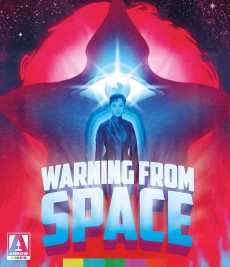
The starfish from spaceA spaceship with inhabitants from the planet Paira travels to Earth to warn it of an impending collision with Planet R. The aliens have the shape of a starfish with an eye in the middle, which causes panic when they appear on Earth. In a second attempt, one of the leaders takes the form of the famous singer Hikari Aozora so that he can contact the scientist Matsuda. Matsuda is in the process of developing the formula for a new type of element that has far greater destructive power than the atomic bomb. But when Matsuda is kidnapped by a group of spies so that they can squeeze the formula out of him, and Planet R comes closer and closer to Earth, the situation seems hopeless. The huge success of Godzilla created a whole wave of monster movies from Japan. Produced by Daiei Studios, this movie is the first Japanese sci-fi film in color. Contrary to what the cover suggests, the alien starfish are not much bigger than humans and are trying to save them from an impending disaster. The film's message about responsible use of man-made inventions, specifically alludes to the atomic bombs dropped on Japan during World War II, and shows how nuclear energy can be used for something good. But even without monstrous threats that flatten entire cities, the film creates an apocalyptic scenario in the final third in which the destruction of the earth looms. Very much worth seeing. Two cuts on the Blu-ray by Arrow FilmsIn addition to the original Japanese version, the UK Blu-ray by Arrow Video features the American cut, titled Warning from Space. Right after the opening credits, the US version shows scenes with the aliens discussing their plan. Additionally, at the end you see Ginko transforming back. In both cases, already existing scenes were recycled. At the beginning of the film, the US version is missing the dinner scene at Matsuda's house and a short phone call with the local grocer. In the original version, Japanese text panels are inserted in the scene where the aliens are talking aboard their spaceship. For the US version, this scene was zoomed in and mirrored, since the aliens were already dubbed in English. Additionally, most of the newspaper articles were replaced with English-language alternate scenes. Because of the recycled scenes, the US version actually runs longer than the Japanese version. The transformation scene at the end of the film is unnecessary, but otherwise the differences are relatively minor, so you can definitely go for the US version. Runtimes: US version: 88:00 min. Comparison between the US version and the original Japanese version. [00:00:00][00:00:00]
The US version begins with English language opening credits.
After that, a spaceship lands in a space station. A group of aliens can be seen. One of the beings says that humanity, with its foolishness, must be stopped. The Japanese islands appear to the beings as an ideal landing site. The Number One being is to land first and make contact with the scientists, especially Professor Komura.
The Japanese version shows the original opening credits instead.
US: 2:47 min. JP: 1:48 min. [00:06:11][00:05:11] After the scene in the restaurant, in the Japanese version, Matsuda is shown having dinner with his wife and Taeko. Mrs. Matsuda asks Taeko when she will finally quit her job at the daycare center and marry a man. Matsuda jokes a little and says that Taeko is waiting for a proposal first.
JP: 1:04 min. [00:08:34][00:08:36] After the radio in the store starts working again, the scene continues in the Japanese version. The phone rings and Mikawa is asked about Kamura. He says that he had a drink at the Cosmos cafe.
JP: 14 secs. [00:12:23][00:12:39] The US version shows English language newspaper articles reporting on the UFOs.
In the Japanese version, the newspaper articles are in Japanese.
US: 21 sec. JP: 21 sec. [00:27:10][00:27:27] The scene in which the aliens in their spaceship are talking about how humans are frightened by their shape and therefore they should choose a different form, was mirrored and zoomed in the US version. In the original version, the aliens' dialogue was superimposed on the side in Japanese. By zooming into the picture, these were removed in the US version. In the US version, the aliens speak English, so the text overlays are unnecessary.
US: 2:36 min JP: 2:36 min. [00:53:22][00:53:38] The US version shows English language newspaper articles reporting on Planet R.
In the Japanese version, the newspaper articles are in Japanese.
US: 22 sec. JP: 22 sec. [01:10:12][01:10:27] Before cutting to the clock, the US shows a shot of Planet R.
US: 3 secs. [01:18:52][01:19:04] Curious: In the US version, you see the people longer after the alien asks for Matsuda. The shot was simply frozen.
US: 1 sec. [01:26:14][01:26:26] The US version shows at the end how the alien returns to her original form. To do this, the transformation scene we saw earlier was simply played backwards.
US: 1:33 min. |