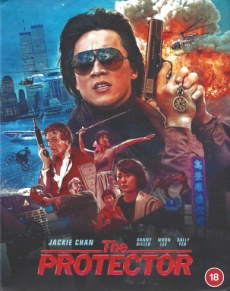
|
buy this title
4K UHD Deluxe Limited Edition 
|
Comparison between the Hong Kong version on the 2026 British 4K remastered Blu-ray from 88 Films and the Japanese version on the 2026 British 4K remastered Blu-ray from 88 Films
- 6 differences
We have already reported several times on Jackie Chan’s failed attempt in the mid-80s to conquer the US market once again as a sort of “Dirty Harry.” The Protector has always attracted interested viewers precisely because of its style, which is so atypical for Chan, and naturally, there was lively debate surrounding the significantly different Hong Kong version (report). As is well known, Chan was allowed to take matters into his own hands for his home market and extensively reshot the fight scenes in particular. In Japan, there was then another slightly longer version (report), in which a few US scenes as well as some exclusive material - primarily in the form of a typical outtakes sequence - were added to the Hong Kong cut. On top of that, the film was initially censored for the R rating (report), and unfortunately, Germany received this shorter version before the uncensored version became the standard on international DVDs. The German Blu-ray premiere in 2014 was finally uncut and even included the Hong Kong version with German subtitles. The quality wasn’t great back then, though; both versions were SD upscales. With the 2019 UK Blu-ray, there was finally a genuine (2K-remastered) HD master for the uncensored US version and the Hong Kong version as an SD bonus.
4K Premiere from 88 Films with Hong Kong and Japanese VersionsAs of May 4, 2026, the worldwide 4K premiere is now available in the UK. Just as with the 4K edition of Dragon Lord shortly before, they’re going all out, adding not only more bonus material but also more versions than on the previous HD release. In addition to the US and Hong Kong cuts in 4K, the Japanese version is now included here for the first time. The set contains two 4K discs and new 4K-remastered Blu-rays with the same video masters. Although the US cut has its fans, the clear highlight here is, of course, the disc featuring the Hong Kong AND Japanese versions. Until now, the Hong Kong version was only available in SD or as an upscaled version. The improvement in quality here is therefore truly enormous. The Japanese version, on the other hand, was already available in Japan on the second Blu-ray release as a theatrical print with burned-in subtitles in HD - though this was, of course, a rather exotic option for international fans. We therefore took a closer look. Basically, nothing new: The differences match exactly those from the old report on the Japanese LD. But we were able to document the improved picture quality and a few other details here as well. We also compared the older releases of the Asian versions; the new 4K reconstructions are faithful to the originals (except for irrelevant differences in the frame area). A thick booklet with beautifully in-depth texts by Thorsten Boose rounds out this substantial box set, by the way. Highly recommended.
Runtime information is organized according to the following scheme Before getting into the actual comparison, please refer to three sets of uncompressed screenshots that we have compiled for further qualitative analysis:
1. 88 Films 4K-remastered Blu-ray (2026) vs. 88 Films Old Blu-ray (2019) vs. Splendid Blu-ray (2014) vs. Paramount JP Blu-ray (2014) -> In 2026, 88 Films used essentially the same restoration for identical material in the US and Hong Kong versions, with only some minor differences in color grading and encoding. The SD versions of the HK edition from Splendid & 88 Films were identical, differing only slightly in the cropping of the frame. The HD upscaled “main version” from Splendid looked better, but of course isn’t particularly impressive anymore these days, given the 4K restoration. * The first scene (arrival at the bar) is interesting; it was actually supposed to have a day-for-night filter, which was implemented differently or not at all depending on the version. * The second image also confirms once again that the censorship in the old R-rated version was not an issue in any of these digital releases. * The third image differs in the Asian versions because an alternative shot was used here for what is essentially the same scene. 2. Comparison of Hong Kong/Japan Bonus Material -> Unsurprisingly, the new 4K master from 88 Films finally presents this coveted version in a respectable format. No differences in quality between the Hong Kong scenes and the US footage are discernible. The Japanese version was already in HD on the Japanese Blu-ray second edition, but it exhibits typical signs of wear and tear and features burned-in subtitles. 3. Japanese Exclusive Material -> A scene in the middle of the film and the outtakes credits were only available in Japan. The quality drops slightly here, but it’s still quite watchable and, of course, clearly better than the old Laserdisc. It is possible that the image source from the Japanese theatrical print was reused here, but color-corrected and restored -specifically, many small imperfections were removed, as were the burned-in subtitles for the brief dialogue (mentioned further down in the report at 50:25 / 51:15–51:44 ). The Hong Kong version starts with a reference to Fortune Star. + 37.5 sec
In contrast, the Japanese version has its own in-house opening. 11.5 sec
The Golden Harvest logo in the Japanese version is the export variant without Chinese characters on the sides. The credits also start on a black background. Japanese version 2.4 sec longer
The different credit language also runs through the rest of the scene - although there are no differences in the editing. This is worth mentioning again because the US version, with the same yellow credits in English, was slightly longer in several places; see another report.
Worth noting is the 22nd minute, because when our police duo flies to Hong Kong here, from this moment on, Cantonese is suddenly spoken in the Japanese version. Earlier in New York, Cantonese was already heard in the Hong Kong version, while the Japanese version offers the original English audio here (like the US version). It’s a somewhat odd hybrid, because Garoni, played by Danny Aiello, suddenly starts conversing fluently in Cantonese with Jackie from this point on - while conversely, in the US version, English is still spoken throughout, even in Hong Kong. 25:00 / 24:37-25:36 We see everyone leaving the room for a longer period of time. This is followed by a scene in which the cop talks to Billy and Garoni. He gives the two a lead that takes them to the sauna, which they check out next - which better sets up the scene that follows in all cut versions. Note: The scene appears in the US cut at 30:32–31:31 (88 Films 2026); so it is not Japan-exclusive material, but merely a scene added to the US version. 59.1 sec
50:02 / 50:38-50:53 Billy and Garoni are seen again (just before Benny Garucci arrives at the airport). They walk away and talk a little. Note: This scene also appears identical in the US cut at 54:29–54:44 (88 Films 2026). 15 sec
50:25 / 51:15–51:44 The scene in which Benny Garucci arrives in Hong Kong is longer: The chauffeur gets into the car and drives off. Then there is a brief conversation between Benny and Ko’s henchman. Note: The arrival scene itself is missing from the US cut, so this section is not included there either. This makes it (along with the outtakes credits) the only scene that is truly exclusive to the Japanese version. 28.3 sec
Alternatively 68:30-68:32 / 69:49-70:58 In the Japanese version, Benny arrives at Harold Kos’s office. They discuss how their businesses are being threatened by the two cops. Note: This scene also appears in the US cut at 62:33–63:45 (88 Films 2026). However, it differs slightly here in that the conversation is even more detailed in the US cut. Even the opening shot of the street outside is longer, and at the end, Ko says that they will take care of the cops + additional reaction shot of Benny.
The Hong Kong version includes a shot of the harbor instead.
Japan version 66.5 sec (= 1:07 min) longer At 90:47 / 93:12, the credits begin in the Hong Kong version. The Japanese version first shows the shot briefly without any text overlays, then the image is “folded” smaller in the center, introducing the outtakes credits.
In the Hong Kong version, the end credits now run to a close (virtually exactly as in the US version, except that the US version features English credits) over the long, continuous tracking shot.
Japan version 137.2 sec (= 2:17 min) longer The final information panel differs slightly.
|