|
buy this title

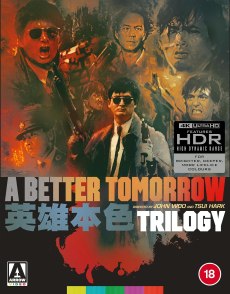
Arrow Video 4K UHD Blu-ray set 
|
Comparison between the unrestored workprint (Shout / Arrow Video) and the reconstructed workprint, the latter included exclusively on a bonus Blu-ray disc in Arrow Video’s UK 4K UHD Blu-ray set
- 13 documented differences
In the report on the workprint of John Woo’s classic A Better Tomorrow II, we provided a detailed summary of the sensation that unfolded during Shout’s worldwide 4K premiere in the U.S. in November 2025. In the studio archives, an early cut of the movie had been discovered that actually seems to represent Woo’s original vision as closely as possible, before Tsui Hark heavily edited the film again prior to its theatrical release. Further background on this, as well as all the details regarding the nearly 40 minutes of additional material, can be found in the previous comparison. Since September 28, 2026 Arrow Video has released the trilogy in the UK as well. Once again, the British boutique label clearly sets the standard here by not only adding significantly more old and new bonus material to complement Shout’s featurettes but also offering more in terms of audio and film versions. As we recall: Arrow released the extended version of The Killer in several different variations and also corrected the festival cut of Bullet in the Head. The workprint of A Better Tomorrow II, on the other hand, didn’t look nearly as abysmal in terms of quality as other workprints, but especially when it comes to color and print damage, the footage falls significantly short of the 4K-restored theatrical version. Arrow Video has now addressed this by including on the bonus Blu-ray in the set both the unrestored workprint (identical 1:1 to the Shout version) and a hybrid cut that combines 4K-restored scenes with the additional material.
The reconstructed workprint hybrid from Arrow VideoFirst, it’s important to note: The main reason for this report is actually that this version runs more than a minute longer. However, this is a fallacy: Up until the end credits, the version is virtually frame-for-frame identical, and the difference in runtime stems solely from the fact that those very end credits (which are entirely missing from the workprint) are shown in full here. Throughout the film, however, there are further minor discrepancies. Nothing earth-shattering, and, for the most part, all already known from the previous comparison. In any case, for several “more unusual” scenes, presumably for the sake of simplicity, the 4K-restored footage from the theatrical version was used, meaning that a few cross-fades or similar effects do not, in fact, match the workprint exactly. To what extent this might bother purists is up to each individual viewer to decide. Ultimately, it’s a double-edged sword. On the one hand, it’s clearly an added value from Arrow: Many scenes included in their entirety in the theatrical version look significantly worse in the unrestored workprint, especially in terms of color, so being able to see as much as possible in better quality in this hybrid version is great. In and of itself, this often-brief supplementary material is also virtually complete, but it should be noted here that, on the one hand, not every extension was incorporated frame-for-frame (as in The Killer and Bullet in the Head). In most cases, longer segments from the workprint source were generously integrated, which means fewer jumps in quality but, conversely, significantly more material in poorer quality than is actually necessary. On the other hand, regarding the scenes documented below one can’t help but wonder why, given all the meticulous work put into the other 150-plus differences, they didn’t also reconstruct these scenes faithfully to the original and instead show the altered bits of the theatrical cut. But either way: this is just nitpicking at a high level; the Arrow release comes highly recommended to every Woo fan. Finally, on a technical note, it should be mentioned that this hybrid version was actually created using playlists (essentially seamless branching). So it’s not two simple, separate film streams; instead, identical footage is used from both the unrestored workprint and the hybrid version. Consequently, nothing has been unnecessarily compressed here, and the quality has been maximized to the fullest extent possible on this 50GB disc, which is packed to the brim. Conversely, this also means, of course, that the workprint segments in the hybrid version are presented 1:1 without further color correction and with all signs of wear and tear intact. No further restoration has been done here. After the identical description of the workprint, the Cinema City logo differs.
In the scenes from Part 1 at the beginning, the unrestored workprint still uses a picture master with burned-in subtitles, whereas the rest of the actual film is clean. That is, without burned-in subtitles, unlike the festival cut of Bullet in the Head. This also serves as an example of what scenes, excluding the extended content, look like in the restored version from Arrow Video.
02:46–02:48 / 02:46–02:47 While the introductory flashback was frame-for-frame identical, the final shot of it (before the title card appears) is a moment longer. Here, some smudges appear in the frame, but the hands move a bit further - whereas the shot in the theatrical version freezes for just under a second, and thanks to the 4K source material, this detail was carried over to the Arrow Hybrid Workprint as well. Workprint 0.7 sec longer
02:56 / 02:55–02:56 Another curious detail: After the title card fades in, the image of the following scene is frozen for a moment earlier in the theatrical version, and Arrow carried this over in their hybrid cut as well. In the unrestored workprint, however, a blue stripe briefly appears on a black screen, and then the following scene begins immediately. The theatrical cut is 0.7 sec longer
From 04:30–06:44, the theatrical version featured credits superimposed over the montage of Kit driving with dance scenes at the ball, and Arrow has carried this over into the restoration as well.
At 06:00–06:11, a brief exchange between Lung and his daughter Peggy marks the first “real” expansion of the workprint. To achieve this, Arrow switches back to the lower-quality source material of the original workprint right at the shot immediately preceding it, at 05:52. The stills below show the frames before and after this transition.
Here are some examples from 10:22, as well as 24:09, 80:23, and 116:13 to illustrate why Arrow’s restored hybrid version is well worth it: Some scenes were noticeably color-distorted, often with a strong greenish or bluish tint, or simply much too dark. Of course, the 4K-remastered version also doesn’t show the various splices or other damage.
From 10:32–14:27, the Arrow reconstruction switches entirely to the lower-quality footage from the workprint. In fact, within these four minutes of film, there are actually “only” 7 individual extensions, which add up to almost exactly two minutes. Theoretically, Arrow could have shown nearly two more minutes of higher-quality footage within this block; however, they opted for such an extensive replacement in order to minimize jumps in quality. This pattern continues throughout the entire film; even with many individual differences within single scenes, the lower-quality footage from the workprint is used liberally. Note: The re-ordered scene at 28:36 in the restored version matches the unrestored workprint. Unfortunately, this applies to the footage here as well, even though the scene where Kit crumples up the note, which also appears later in the theatrical version, could have been incorporated from the restored 4K footage. As mentioned, footage was generally used on a very large scale, and they took the easy way out here as well. At 32:08, the city title card is still missing from the unrestored workprint.
78:59 Actually, there’s a smooth fade from the red light to Kit in bed. In the unrestored workprint, it’s a hard cut.
All releases of the theatrical version (since VHS) have had a few blood spatters that were obviously added later in a rather cheap manner; this is particularly noticeable here at 85:33. Even as the guy falls backward, a red smear moves roughly across his chest. The unrestored workprint was, of course, still unedited here, but Arrow’s hybrid version uses the post-processed footage from the theatrical version.
It’s quite curious: At 86:18, there was a moment, lasting just one second, showing a shot of a man approaching, which was incorporated into Arrow’s hybrid version, even though the footage before and after it (unlike other scenes that were extensively incorporated) comes from the 4K footage. In thsee slow-motion shots here, artificially added blood spatters can once again be seen in a few individual frames in the theatrical version - and thus also in the reconstructed workprint extended cut.
Another striking scene featuring a blood cloud that was artificially enlarged in all theatrical versions, and can be seen unedited only in the raw workprint, can be found at 88:58.
89:55 After Lung whimpers for a bit longer, the following scene fades to black in the theatrical version, and Arrow carried this over to the “Workprint Extended Cut” as well. No time difference
Alternative 112:20–112:22 In the theatrical version, the image briefly freezes during the shot at Kit; the muzzle flash was added to the frame here. Arrow adopted this approach for its own hybrid version as well. In contrast, the shot in the unrestored/original workprint is longer at the end, and you can see Kit stagger backward after being hit. No time difference
141:08–141:39 / 141:08–142:50 The theatrical version features conventional end credits superimposed over a frozen frame, and Arrow presents it exactly the same way in its in-house reconstruction.
In the workprint, there are only a few credits specific to the restoration and, finally, the title card.
Arrow’s reconstruction of the workprint is 70.7 seconds longer |