|
buy this title
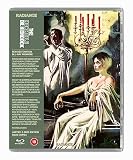
UK Blu-ray with all three versions 
|
Comparison between the edited US version and the uncut original version (both included in the British Blu-ray set from Radiance Films)
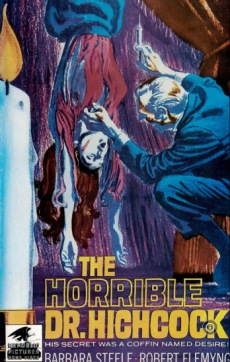
History and Confusion Regarding DR. HICHCOCK This may sound like wild trash, and it's even more surprising how well the resulting film turned out. The score by the already renowned Roman Vlad creates a great sinister atmosphere, the actors delivered their best during their 18-hour days, and cinematographer Raffaele Masiocchi captured some truly beautiful shots. The many elements borrowed from Hitchcock classics, especially Rebecca, are charmingly integrated rather than feeling cliché. The inclinations of the titular doctor to sedate his lovers and ultimately resort to necrophilia are told with atmospheric horror, without excessive sensationalism. But how did this Gothic horror film end up with the many alternative titles mentioned earlier? The title Raptus was initially chosen in Italy to sell the film to the well-known US production studio, American International Pictures (AIP). In line with the still relatively fresh success of Psycho at the time, "Raptus" refers to a mental disorder. However, AIP found the material too extreme, so the strategy didn't work at first. Two years later, there was a US release under the Horrible title. The film was now cut by over 11 minutes and marketed as a double feature with The Awful Dr. Orloff. The American Blu-ray release in 2016 by Olive Films only had the shorter US version. Fortunately, the 2018 Blu-ray release in Germany by Ostalgica included the uncut original version. As of October 23, 2023, a new Blu-ray from Radiance Films is available in the UK. This release features a new 2K restoration of the film, which is significantly better in quality than the previous versions. In addition to newly produced bonus material and an extensive booklet, this release provides the full package in terms of versions: the uncut version in the original Italian form and the slightly different Raptus version. Furthermore, on Disc 2, the US version has been reconstructed from the same master. Differences in the US Version Questionable are some re-cuts, additional blending effects, and added dialogue moments. In the beginning of the film, there are repeated scenes of a carriage moving, achieved by recycling and slightly manipulating later shots. This may have been meant to hint at the upcoming events, but it's rather confusing. Several soft dissolves or black fades were clearly creative decisions that were not in line with the Italian creators' intentions, often used to make cuts less obvious. There are also a few additional lines of dialogue, apparently meant to provide explanations to the seemingly less attentive US audience regarding the plot here and there. Turning an obvious family crypt into a working laboratory through new comments seems rather out of place though. To clarify, there are no censorship cuts. Only shortened shots of Steele in the coffin at the very end could be interpreted as minor censorship, but these appear to be simple trims after all. There were no objectionable nude or sexual scenes in the film. In this context, it's interesting that the booklet includes a quote from assistant director Marcello Avallone, stating that, besides the relatively tame version for the Italian market, more explicit variants of specific scenes were shot, especially for distribution in Japan. Unfortunately, there is no further evidence on this matter. It is also possible that Avallone confused this with another film, but as we were not able to check Japanese VHS copies yet, this remains a question mark. In summary, some changes in the US version can be viewed critically, but for the most part, the alterations work well, giving the film a bit more momentum. The new release from Radiance is recommended to all interested parties, as it includes both versions in the set. From our perspective, we also recommend the audio commentary by Tim Lucas, in which he discusses the background of the three versions and other differences from the original book adaptation. Runtime indications are arranged according to the following pattern: Introductory look at the Raptus version, which is selectable on Disc 1 alongside the Italian original version. The same picture master is used, and the differences are actually limited to the opening credits, a short newspaper shot at 19:30, and the end credits.
Re-cut 00:00 resp. 01:39-02:45 / 00:00-02:07 resp. 03:46-03:49 In the US version, the opening credits, as shown earlier, were pushed back a bit and appear after the short cemetery scene. In addition, some title cards were cut. Almost all crew members were given newly devised English names, some of which resulted in rather absurd outcomes, such as the much-quoted "Frank Smokecocks". Perhaps because of this, some trimming was applied for the US release. The title card was also replaced, but otherwise, the credits are identical, in yellow on a black background. The following exterior shot with the caption "London 1885" is also seen in the US version, but the subsequent exterior shot, which follows the coffin scene, is considerably shortened. Original Version is 56.5 seconds longer
00:59 / 03:06-03:07 When the coffin is being worked on, the end/start of two shots was slightly trimmed. 1.7 seconds
03:53 / 04:51-04:55 The assistant retrieves Dr. Hichcock's (Bernard) work tools earlier. 3.5 seconds
Re-cut 04:36-04:44 / 05:37-05:39 In the US version, there's a soft dissolve to an exterior shot of a carriage, and another soft dissolve to Bernard walking outside. In the original version, the shot inside is slightly longer. US Version is 6.7 seconds longer
The same shot appears later in both versions at 30:35-30:43 / 33:54-34:02, making the US version contain the same shot twice. A direct comparison reveals that the image in the US version has been darkened slightly to conceal this additional use at the beginning.
Re-cut 04:51-05:07 or 06:27 / 05:46-05:54 or 07:18-07:34 At this point in the original version, an exterior shot is significantly longer. In exchange, the US version inserts an extended shot of Bernard playing the piano indoors, which originally occurs almost 1.5 minutes later and is followed by another shot of him playing the piano. Original Version is 8.4 seconds longer
05:27 / 06:14-06:15 A slight trimming of a few unimportant frames. 1.4 seconds 05:42 / 06:31-06:33 Before Bernard ascends the stairs indoors, another minor trim was made. 2.3 seconds 07:27 / 08:34-09:12 In his room, Bernard first locks the door, checks another window to ensure he's undisturbed, and then retrieves a small box. With a key also dug out, he returns to the door. 38 seconds
08:02 / 09:47-09:50 Bernard stands in front of the next door for a moment longer. 2.6 seconds At 10:25-10:26 / 12:13-12:14, only the US version has a fade in/fade out. Re-cut 11:26-11:36 / 13:14-13:15 In the US version, there's a brief soft dissolve to an exterior shot of a carriage. In the original version, the shots follow one another, with Bernard holding his syringe first in the operating room and then in his room. US Version is 8.7 seconds longer
The same shot appears later in both versions at 16:55-17:05 / 19:41-19:51. In a direct comparison, the image has been significantly brightened and mirrored in the US version to accommodate the previous placement.
11:38 / 13:17-13:18 Bernard is seen a bit longer. 1.3 seconds At 11:46 / 13:26, you only hear Margaretha's off-screen voice saying in the US version, "Darling, I've been waiting for you."
At 13:40-13:41 / 15:20-15:21, only the US version has a fade in/fade out. 14:07 / 15:47-15:55 A shot of the pallbearers begins earlier. 7.8 seconds
14:13 / 16:01-16:03 The subsequent shot of Bernard and Martha starts a little earlier. 1.6 seconds 14:32 / 16:22-16:25 Another minor trim in an unimportant part. 3.1 seconds 14:48 / 16:41-17:08 The last outdoor shot is somewhat longer. Inside, there is a long camera pan from a skull (including a menacing score) towards the door, where the pallbearers enter shortly after. In the middle of this, the US version picks up. 26.9 seconds
At 15:11 / 17:31, the pallbearers converse about the strangeness of burying one's own wife in the laboratory, but the other speaker suggests that the doctor is generally peculiar. This is a rather nonsensical change since it's quite evident that this isn't really a laboratory.
15:40-15:41 / 18:00-18:18 After fading to black only in the US version, the black screen is slightly longer there. This also shortens the beginning of the following scene, where Martha gives some instructions to the workers and stands in front of Bernard a bit earlier. Original Version is 17.2 seconds longer
16:43-16:45 / 19:20-19:31 Once again, there is an additional fade in/fade out in the US version, while in the original version you see Martha a bit longer as she leaves the room. Original Version is 8.4 seconds longer
There's another fade in/fade out for the following scene, where, in the original version, you first see the carriage. At 18:13 / 20:59, Bernard comments only in the US version that this is where his laboratory was years ago.
19:17 / 22:02-22:06 The camera movement through the room starts earlier. 3.8 seconds 20:11 / 23:00-23:02 Martha comes down the stairs a bit earlier. 1.4 seconds 20:20 / 23:10-23:12 Bernard is seen a bit earlier as he greets her. 1.8 seconds 20:25 / 23:17-23:20 More minor trimming. 2.3 seconds 21:06 / 24:01 Similarly, when Bernard says goodbye. 0.7 seconds 21:45 / 24:40-24:42 Bernard and Cynthia enter their bedroom a bit earlier. 1.7 seconds 23:14 / 26:11-26:13 The US version shortens the shot of Martha looking critically at Bernard with a soft dissolve. 2 seconds At 26:03-26:04 / 29:01-29:04, the US version has a fade in/fade out, and it's slightly longer by 0.7 seconds. 30:35 / 33:35-33:54 Cynthia and Kurt sit together in the carriage for a longer period. He gives her a hesitant compliment, and she thanks him. In the original language, according to subtitles, this translates to "At first I admired Professor Bernard. Now I envy him." In the English Raptus dub, he says, "Before now, I'd never met such a charming interest... in our science." 19.1 seconds
Re-cut 34:01-35:21 / 37:20 or 41:23-42:24 After Cynthia faints, the US version offers a camera pan to the door. The handle is moved multiple times, accompanied by ominous music. Then Cynthia wakes up and looks through the keyhole. At least the latter part of this scene appears a bit later in the original version, after the scene with Bernard at the clinic. US version is 19.3 seconds longer
38:39 / 40:39 Bernard's walk through the hallway was slightly trimmed. 0.5 seconds 39:22 / 41:22-41:23 While there's a soft dissolve in the US version, you can see Kurt in the hallway for a bit longer. Additionally, this is followed by Cynthia waking up, as previously described. 0.8 seconds 40:39 / 43:41-43:42 Cynthia and Bernard enter the hallway slightly earlier. 1.3 seconds Alternative Scene 43:15-43:18 / 46:18-47:57 In the original version, Kurt walks away a bit longer. Then, Bernard and Cynthia are seen together in the room. Initially, you can still see the large portrait of Margaretha above him, and it zooms in. Bernard smokes a cigar and appears absentminded. Suddenly, he mentions that he needs to return to the clinic. Cynthia comments that he has changed and she probably doesn't mean as much to him anymore. Bernard reassures her a bit and offers to have Martha keep her company. Cynthia declines and says she'll stay awake until he returns. Bernard emphasizes again that it could get late. Both walk away, and in the background, you see Martha again. Finally, the subsequent camera movement begins slightly earlier.
In the US version, there's an additional exterior shot of the clinic, explaining the change of location in the following scene.
Original version is 95.7 seconds (1 minute and 36 seconds) longer 45:22 / 50:01-50:02 The final shot of Kurt in the clinic is slightly longer. 1.7 seconds In the following shot, Cynthia's contemplation is only heard in the US version. She thinks about the previous dialogue regarding the locked door. The line "It's always been locked" is repeated multiple times until Cynthia finally stands up.
48:51 / 53:31-53:35 Cynthia takes one step forward and the subsequent shot starts a bit earlier. 4.3 seconds At 50:54-50:56 / 55:38-55:39, the US version has another fade in/fade out, and it's slightly longer by 1.1 seconds. 50:59 / 55:43-56:03 Inside the house, the scene starts with Bernard lying thoughtfully on the bed. He gets up and walks through the room, and then the US version abruptly cuts in. 20.3 seconds
52:23 / 57:27-58:35 Bernard turns around outside for a longer time and goes inside. There, he is shocked by a ghostly figure in the bedroom - the white dress hanging there is illuminated from the outside, making it look like Margaretha. Bernard regains his composure and continues on. The surroundings are briefly lit up in different colors by the thunderstorm. Finally, he walks back outside and calls for Cynthia again. 67.4 seconds (1 minute and 7 seconds)
52:52 / 59:04-60:48 Inside, it starts with Bernard sitting around, lost in thoughts. He goes to the window and looks outside with a slightly insane look. Then he sneaks around the house, illuminated by the candle holder in his hand. Quietly, he enters Cynthia's room and stands next to her. When he puts down the candle holder, the US version joins in. 104 seconds (1 minute and 44 seconds)
55:00 / 62:56-63:13 The camera movement through the rooms begins significantly earlier. 17.1 seconds
At 55:37-55:38 / 63:50-63:52, the US version has another fade in/fade out, and it's slightly longer by 1.1 seconds. 56:30 / 64:44-64:46 When the men go into the next room, it's tightened a bit. 1.8 seconds 58:02 / 66:18-66:25 With a soft fade, an outdoor shot that was supposed to introduce the scene change is skipped. The subsequent shot inside actually starts much earlier. 7.5 seconds
60:57 / 69:20-69:44 Bernard works at the medicine cabinet for a significantly longer time and then closes it. 23.9 seconds
63:15 / 72:02-72:13 With a soft fade, it is omitted that Bernard actually takes a few steps back at the end of the shot. 11 seconds
At 64:29 / 73:27-73:29, the US version has another soft fade, shortening the transition by 1.4 seconds. 66:56 / 75:56-75:59 Cynthia and Kurt are seen a bit earlier. 2.9 seconds At 67:30 / 76:33-76:34, the US version has another soft fade, shortening the transition by 1.3 seconds. 68:08 / 77:12-77:58 Cynthia runs through the room and grabs her bag. Anxiously, she turns around and pauses at the door, while footsteps can be heard outside. 45.6 seconds
Re-cut 70:06-70:27 / 79:55-80:26 The US version here uses about 10 seconds of Cynthia in the coffin earlier and only then jumps to a later moment in the long shot of the coffin. In the original version, the scene starts with this wide shot of the coffin, and then you see Cynthia for a longer time in one continuous shot. Illustrated here as a progression from the original version, with the shot of Cynthia as mentioned also appearing in the US version, just shifted forward. Original version is 8.7 seconds longer
70:41 / 80:39-80:56 Cynthia's attempt to free herself is longer from the overhead view, and the side shot also starts significantly earlier. 16.6 seconds
Re-cut 70:49-70:52 / 81:04-81:06 Before the coffin tips over, the US version reintroduces a short part of the frontal shot from the previous cut. Instead, the side shot is actually a bit longer. US version is 1.1 seconds longer 72:42 / 82:56-82:57 Cynthia runs to the gate a moment earlier. 1.1 second 73:37 / 83:52-84:38 Kurt climbs much longer on the house. When he finally gets inside, he still runs in a first shot. 45.8 seconds
73:48 / 84:49-84:53 Kurt walks through the next corridor earlier. 4.5 seconds
75:18 / 86:23-86:24 An initial shot of Margaretha in the sea of flames begins a bit earlier. 1.1 second
Slipcase and reverse cover of the UK Blu-ray:
US VHS by Republic Pictures Home Video (1986):
|