|
buy this title

|
Release: Nov 02, 2025 - Author: Muck47 - Translator: Muck47
Comparison between the recut and the original version, both available on the American 4K Blu-ray from Kino Lorber
39 changes, incl. intro/end credits
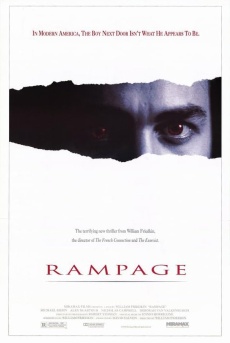
In 1987, iconic director William Friedkin did not have much luck with the distribution of his serial killer thriller Rampage. Europeans (including Germany and the UK) and Japanese audiences were able to enjoy this first original version of the film. It was also shown at at least one festival in the US, but the production company De Laurentiis Entertainment Group then went bankrupt. It was not until 1992 that Miramax bought the rights for theatrical distribution in the US, and in the process Friedkin made extensive changes to the film. His “recut” was the first and so far only version of the film that Americans have seen. In Germany and many other countries, there wasn't even a DVD release after that. On October 21, 2025, Kino Lorber now released the 4K premiere in America, and fortunately, the label restored both cuts of the film in 4K. The original version comes from the original 35mm camera negatives, while the recut comes from the 35mm interpositive. Highly recommended for any Friedkin fan. In the report between the “Original Cut” in 4K and the German VHS, we have already noted that the actual original version was about a minute longer at the time due to a concluding speech by Charles to the jury as well as an alternate scene with the stenographer. This is missing from both film versions on the 4K release and is also not included in the bonus material. This is unfortunate, but acceptable. As already summarized in the first report, a significant difference between the original version (whether on VHS or in 4K) and the 1992 recut lies precisely in the fate of Charles. SPOILER: As explained in more detail below, he only dies in the original version, and the debate that determines the film's content, namely whether he was sane when he committed his crimes, is resolved differently here. It is noticeable that the recut is structured in a much more “conventional” way. An additional scene at the beginning, in which Charles buys the gun, immediately sets the tone with regard to his sanity. Michael Biehn's character Anthony also has a more detailed conversation with a family man whose relatives were killed by the assassin, so it's way clearer for both him and the audience. Conversely, in the original version, Anthony struggles much more with his attitude toward the death penalty, which is expressed through several monologues into a tape recorder and through various scenes with his somewhat estranged partner Kate. In any case, it is clear that Anthony's private problems have been reduced to a minimum in the recut. More difficult to classify are a few newly recorded dialogues, some of which also differ (rather insignificantly) in content, but otherwise mainly feature different speakers. Ennio Morricone's score is the same in both versions and remains unchanged in the recut. In a few cases, material, especially in the finale, has been slightly re-edited, thus altering its effect in some respects. All in all, both versions have their charm and focus on clearly different aspects, so we can be glad that, decades after production, both versions are finally available in similarly good picture quality.
Running times are listed according to the following scheme
Other logos at the beginning thanks to different publishers.
Recut 8.2 seconds longer
Alternative / Additional material in recut version 00:16-02:18 / 00:08-01:56 The original version starts directly with the title screen and a few credits. This is followed by a long shot of fields from above with music. The camera zooms in and at the end you can see Charles crossing the street in his red jacket.
In the Recut, Charles is seen walking down the street for the first time and stopping with a grin in front of the house where he will soon find his victims. Then only the title is shown and it is pointed out that the film is based on true events. Charles is then seen entering a gun shop. He asks to see a pistol, but the salesman says there is a 15-day waiting period. Charles asks if he needs ID and the man explains that a California driver's license is sufficient. However, he still has to ask a few questions. Charles denies any statements regarding mental illness and is handed the pen.
Recut 14 sec longer Immediately afterwards, only the recut has two notes.
Here is a small image comparison. The 4K scan of the original version tends to be slightly darker and uses different color filters in some cases – this is particularly noticeable in the CT scan at the end of the film.
06:17 / 05:55-06:33 Anthony enters the courthouse. He watches as the letters for a judge's name are put up. 38.6 sec
14:27 / 14:43-15:13 Anthony sits dejectedly on the bed in the evening and tells his wife that he saw Molly (their dead daughter) today. She says that happens to her a lot too. He apologizes and she says it's not his fault. The audio commentary also emphasizes that Miramax's recut greatly reduced the focus on Anthony's family's personal tragedy and focused the film more directly on the main story. 29.8 sec
18:42 / 19:28-19:55 Anthony leaves the building with Kate and discusses the right approach (whether to work toward the death penalty). He asks for her help, but she insists that this goes against everything they both believe in. Kate says he has a chance and a responsibility to say that it is wrong to kill. 26.7 sec
In the shots of Charles' hideout 25:38 / 26:51, it is noticeable that the original version has significantly reduced color.
Alternative/ Additional material in the recut version 36:04-36:34 / 37:17-37:39 When Anthony hears about the crime, the recut version switches to a view of Charles (which only appears in the finale in the original version) and after another shot of Anthony, he thinks of his daughter Molly sitting on a rock by the water. Charles now slowly appears in the picture, or rather Anthony obviously imagines how he would have appeared here as his daughter's murderer. This is followed by a brief shot of Molly in the hospital on a ventilator and Charles in prison.
In the original version, Anthony is shown a little longer, followed by a shot of the blood-stained crime scene. Anthony again, then Charles grabbing something and Gene mourning a little. This is followed by a shot of Anthony's daughter throwing something at Kate in slow motion.
Recut 7.2 seconds longer 38:02 / 39:07-39:36 The investigation continues a little longer. They look at a calendar in which dates are repeatedly marked with circles and the word “Today.” Anthony instructs them to cross-check unsolved murder cases with the dates to see if there is any intent behind them. They should also include LA and Kern Counties. 29.1 sec
Alternative / Additional material in the recut version 38:58-39:06 / 40:32-40:40 In the original version, the X-ray image of the regions in the brain is visible for a significantly longer period of time. The recut briefly switches to Anthony and Al. In addition, although the scientist's commentary here and shortly before is largely identical, it is spoken by a different narrator. No time difference
Recut 39:22 / 40:56-41:01 At the beginning of the follow-up shot, the scientist says: “Brain tissue appears normal.” 4.4 sec
Additional material in the recut version 46:35-47:26 / 48:14 Before Gene drives to the motel with his son Andrew, he talks to Anthony in the recut about the decision to impose the death penalty. Early on in the film, he makes it clear that death is sometimes the better choice and actively asks Gene for his help in taking this step for Charles. Anthony: “When my daughter lost consciousness, I had to make the decision to let her die. I thought it was better for her. I feel the same about Reece. Sometimes, a life has to be taken. I need you to help me.” Gene: “What if I just don't show up?” Anthony: “I could have a warrant issued for your arrest, but I'd rather not. Believe me.” Gene: “Yeah, I thought a lot about everything that happened. We didn't go to church, I ain't got no religion, nothing like that. I think all this was God's idea.” Anthony: “I don't know, Mr. Tippetts, I just wanna see Reece punished for what he did.” Gene: “See, I don't know why—to your little—but I think God, he, he made a judgment against us.” + 50.4 sec
Alternative / Additional material in recut version 51:12-52:51 / 52:01-53:44 Before the trial begins, there is a completely different scene to see. In the original version, Anthony talks to Kate in a café. She tells him about an urban planning conference next week at a nice hotel. However, she says she won't be going because she already knows that Anthony won't be joining her. He asks for her understanding and says that he doesn't want to sacrifice their relationship for the case. However, the jury has just found Charles guilty on all counts.
In the Recut Version, Anthony discusses the next steps with his lawyer Al and the judge. The lawyer wants a fairly straightforward conviction, but Anthony criticizes that he has seen this happen many times before: someone is sent to a mental hospital, then classified as no longer dangerous and released. He refers to a perpetrator who recently raped a girl and cut off her arms, and who has just been released. The judge briefly emphasizes that he would not allow a mental hospital and would ensure that Charles goes to prison. However, Anthony is skeptical that anyone will still remember this in a few years' time when there is a new hearing. The judge believes that with a maximum sentence on his part and critical voices from the community, this will not happen. Al addresses Anthony critically again, who remains convinced that he can get Charles convicted. In addition, the court proceedings begin earlier here. The details of how a court case involving mental illness works are explained in more detail here, especially for viewers who are unfamiliar with the process. First, the perpetrator must be found guilty, then their sanity at the time of the crime must be proven. In the third step, the sentence is determined, or in this case, the decision for or against the death penalty.
Original version 5.1 sec longer 59:47 / 60:40-60:53 The exterior shot of the house is slightly longer. Inside, we first see Kate saying, “Tony, there's something I want to tell you.” 12.3 sec
59:55 / 61:01-61:08 After seeing Anthony concentrating on his documents, another shot of Kate is missing. She continues to look over at him, the phone rings off-screen, and she gets up. 7.4 sec
Additional material in the recut version 60:45-60:50 / 61:58 Interesting: In the original version, Anthony hangs up immediately after telling Charles that he will only talk to him through his lawyer. In the recut, the scene cuts to Charles, who laughs and then hangs up. In the recut, Anthony also hangs up, but this additional cross-cut means that Charles retains “control” over the situation, at least in the recut. + 5.1 sec
61:08 / 62:16-62:29 The conversation between Anthony and Kate is slightly longer in the original version. 13.4 sec
63:49 / 65:10-65:15 Charles is briefly seen again in the prison transport vehicle. 4.3 sec
63:53 / 65:19-65:39 Before the police officer removes Charles' handcuffs, they talk briefly. The police officers are eating donuts and Charles asks if he can have one. He says that otherwise the medication will suppress his hunger. The police officers jokingly reply that the donuts could be poisoned, since it seems that everyone in the world is out to poison Charles. 20 sec
64:33 / 66:19-66:22 Charles says at length: “(I must have been real sick to do all that. I'da never done nothing like that if I was myself.” 3.2 sec
|