|
buy this title
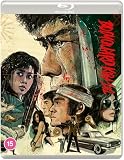
UK Blu-ray set with both versions 
|
Comparison between the US version and the Japanese original version, both included on the British Blu-ray from Eureka Entertainment 26 differences Runtimes: Quentin Tarantino, the old rascal: He obviously didn't pick up the (alleged) Bible quote Ezekiel 25:17 from Pulp Fiction in the holy book, but it comes from the US version of the film we're talking about in this article. Karate Kiba or Bodyguard Kiba was made in 1973 shortly before Sonny Chiba's mega-success as The Street Fighter. The film is based on a manga by Ikki Kajiwara and naturally provided a nice vehicle for Chiba, who portrays a similarly overpowering character here as in his subsequent hit. In the 90s, Takashi Miike produced three new adaptations of the material. There are two main versions of the film, but they differ even more fundamentally in terms of content than we can naturally reproduce here in the report. The English dubbing is extremely unique in this case: While Chiba is a karate master in the original who wants to bring his martial art to America and build up a bodyguard business on the side, so to speak, in the US version he is a typical loner hero who consistently stands up to drug-related crime. Any philosophy about karate and approaches influenced by Chiba's real master Masutatsu Oyama are more or less consistently ignored in favor of a conventional action story. And the other changes can be categorized in the same way. On the one hand, there is additional material, which should provide more appeal in the West with references to Bruce Lee and American martial artists as guest stars. And that includes the cool quote at the beginning. On the other hand, dialogue scenes have been cut, most of which are about Chiba's karate mission. Dramatic climaxes towards the end with the two women at Chiba's side have also been cut. There weren't many international releases yet and on DVDs in English-speaking countries, the US version was of course usually more common - often nastily zoomed to full screen and of lower VHS quality. Since March 25, 2024, a highly recommended Blu-ray set has once again been available in the UK from Eureka Entertainment, which includes both versions of the film and also Part 2. As can be guessed from a few moments with burnt-in Japanese subtitles, the US version was apparently reconstructed on the basis of the HD master of the original uncut version. Runtime information is arranged according to the scheme Additional material in the US version
00:00-01:29 / 00:00-00:15 The original version has the Toho logo at the beginning, for which you can already hear the church bells off-screen.
The US version, on the other hand, starts with the fake bible quote, which Tarantino later recycled for Pulp Fiction. It is also read aloud from off-screen - and it is of course remarkable that at the end, instead of the "Lord" of Jules, "CHIBA the BODYGUARD" is mentioned here instead. The movie continues with archival footage from the USA, accompanied by the score.
US version 73.5 sec (= 1:14 min) longer Shortly afterwards, the image zooms in for a moment in the US version (until the beginning of the massacre, which is also introduced with a strong zoom in the original version). In this way, the Japanese subtitle, which is firmly burnt into the image, is not visible.
Note: Later, however, at 36:20 / 33:57 or in the 44th / 42nd minute as well as several times in the scenes that follow, JP subtitles can also be seen in the US version of the Blu-ray. Presumably this wasn't the case in these scenes before for the original US release, but Eureka didn't want to do without the fancy HD master from Japan during these moments.
Alternate / Additional material in the US version 02:09-02:18 / 00:55-01:06 Different newspaper clippings, with the main difference being the name of the don. Only the last close-up (without the name) is using the same shot. Original version 0.5 sec longer
Re-ordered scene / Additional footage in the US version 02:24-07:03 / 01:12-01:24 Although the credits sequence starts similarly on blood splatter...
...then the credits continue in the US version over a training sequence in the forest, which also appears later (see below) without credits in the original version. You can also hear shouts of "(Viva) Chiba!" in the US version. The US martial artists Aaron Banks and Bill Louie, who only appear in the US version in the following intro block, are also mentioned prominently at the beginning. In general, the names all sound suspiciously Western for a Japanese production. The dark score is followed by shots from the streets of New York (which do not appear in the original version) and the tracking shot leads us to the New York Karate & Kung Fu Academy in the middle of the red light district. A man with a half bald head is on the phone in his office.
This is followed by a small training fight between Bill and a dark-skinned fighter and several fighters in white coats. There are posters of Bruce Lee in the background and Aaron watches Bill dispatch all the attackers with ease. Aaron praises Bill, but says Sonny Chiba would finish his opponents differently. To demonstrate, a few fighters have to suffer again, his attacks are a little harder. Bill is amused and again praises Bruce's style and grabs nunchucks. Aaron asks where Chiba is at the moment. Bill replies that he's at the airport on a secret mission against a drug gang.
This switches to the airport, where you get to see a few first shots.
US version 266.1 sec (= 4:26 min) longer 08:37 / 02:58-03:02 When Kiba steps between the guy's legs, the image freezes briefly before zooming in on his face and a few credits appear. 4.8 sec
08:39 / 03:05-03:14 Same pattern. 9.2 sec
08:42 / 03:17-03:25 Ditto. 7.9 sec
08:48 / 03:31-03:37 Ditto. 6.1 sec
08:54 / 03:43-03:51 Ditto. 7.6 sec
09:17 / 04:14-04:23 After a short breather, the race continues accordingly. 8.7 sec
09:20 / 04:25-04:34 Kiba's jump is also interrupted. 8.9 sec
09:21 / 04:35-04:39 And again, before the teeth fall out. 4 sec
09:24 / 04:42-04:47 One last time. 4.7 sec
Re-ordered scene 10:26-10:46 / 05:49 or 08:16-08:36 The US version already uses a part of the press conference here, where Kiba in the English dub makes a clear statement to the drug dealers and promises to bring them all to justice. In the original version, it comes (with a completely different comment by Kiba) within the following scene block and is slightly longer there. 11:48 / 06:51-08:44 The shot from a distance actually runs longer and Kiba stands up. In the original audio, his statement directly before was already different here, as Kiba was addressing his master Tetsugen Daito here. A reporter then says whether this is the "Bull Killer". Kiba is a little annoyed at this rather bad reputation and the reporter's ignorance. The guy apologizes and Kiba calms down again. He says that he will work to maintain the good reputation of his Tesshin school while his master continues to train. This introduces a clip with the scenes in the forest that were used for the opening credits in the US version right at the beginning. Kiba comments off-screen that their destructive technique was not understood by many and that his master emigrated to the USA because his style was not accepted in Japan. In North and South America, he defeated a number of professional fighters and became known as "God Hands". In karate circles, however, he would have continued to be treated rather disparagingly on his return to Japan. This would only be because his master was "too powerful" for them. Back at the press conference, the part previously shown in the US version now follows. However, Kiba says somethings completely different in the original audio (according to the English subtitles). He came to the USA to continue his master's path. After 3 years of intensive training, he sees it as good advertising for his school that he now offers a bodyguard service. Kiba calls his service "God Hands". He is then photographed (missing from the recut US scene block). Original version 92.6 sec (= 1:33 min) longer
12:19 / 09:14-09:17 The exterior shot between two scenes is slightly longer. 2.2 sec 13:33 / 10:31-11:06 Maki sits down at the end of the shot and Kiba explains to her again why he left Japan after fighting with gangs - he simply didn't earn enough back then. But with the bodyguard idea, his school will become famous and she could become his assistant. They both have a drink, Maki doesn't seem convinced. 35.6 sec
41:38 / 39:11-39:12 A few frames are lost during the scene change to the landing plane. 0.7 sec 42:28 / 40:02-40:05 The original version briefly shows another plane during the encounter. 3.5 sec
42:34 / 40:11-40:15 An airplane is also briefly interspersed here. 4 sec 42:36 / 40:18-40:21 Ditto. 3.6 sec 42:38 / 40:23-40:28 And again. 5 sec .
Additional material in the US version 45:06-45:08 / 42:57-42:58 After seeing a burnt-in JP subtitle also in the US version of the Blu-ray shortly before...
...the same shot ends a moment earlier and an English "Morgue" text panel is shown briefly (instead of the black screen of the original version). US version 0.1 sec longer
Alternative / Additional material in the US version 50:07-50:10 / 47:58-48:01 During the conversation in the car, a newspaper clipping was once again exchanged. No time difference
70:45 / 68:36-69:02 After Kiba asks how to help Reiko, the shot actually goes on much longer. Once again, in the original, the dialog beforehand was already completely different: Here, Reiko has spoken of times of hunger and Kiba comments that such hunger would drive one to new achievements. Reiko says, "If a woman wants to win, she can't trust herself.". Women couldn't trust her body either, because it might have a desire for men. She, in turn, would only trust in money. Kiba says that this is how she got her ring. Reiko looks at it again with satisfaction. 26.6 sec
87:19 / 85:36-86:18 Before the close-up of the drugs, Kiba sits next to Reiko for a while and she says that she has lost the game. She goes on to say that her parents were poor and that she hated it. Kiba mentions again that he couldn't make a living from karate alone and that's why he took up bodyguarding. 41.4 sec
87:31 / 86:30-86:35 Kiba can be seen a little longer. 5.3 sec
87:51-87:56 / 86:56-87:38 While in the US version there is only a brief black screen here, the original version shows Kiba at the press conference again. Reporters congratulate Kiba and say that the power of the Tesshin school is now clear to them. The question arises as to why he wants to go abroad. Kiba says that his mission in Japan is done and that he now wants to go global. He stands up, the cameras click again and the picture freezes. Original version 37.6 sec longer
|