|
buy this title
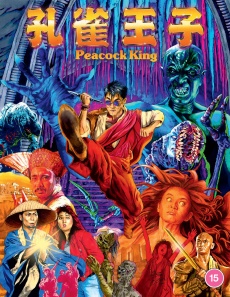
88 Films Blu-ray Limited Edition 
|
Comparison between the theatrical version on the British Blu-ray from 88 Films and the Japanese extended version, included on the Japanese Laserdisc from Pony Canyon and summarized in a featurette in the bonus material on the British Blu-ray from 88 Films
11 differences
Jackie Chan's “brother” Yuen Biao was extremely popular in Japan in the 1980s, and in 1988 he played the lead role in the manga adaptation The Peacock King (and a year later in the sequel Saga of the Phoenix). Nam Nai-Choi (Story of Ricky, The Seventh Curse, The Cat) directed, and as in his other works, there are some creative special effects shots and crazy ideas on offer. Shaw legend Gordon Liu is in the cast, and Hong Kong enthusiasts will also be familiar with Phillip Kwok, Pauline Wong, Gloria Yip, and Kara Hui. The film is a Hong Kong/Japan co-production and, as is often the case in such situations, there was a separate, slightly longer version of the film released in Japan. With over 12 minutes of additional material, it's no surprise that the Japanese actors in particular get a little more screen time. This even goes so far that in one scene it becomes clear that the Japanese hero is essentially given the title role, while in Hong Kong this probably refers to Yuen Biao. Conversely, a few moments are missing from the Hong Kong theatrical version that connect a few scenes in a more conventional way. It seems that the Japanese were considered to be more familiar with the manga source material anyway. On the HD premiere available in the UK since October 27, 2025, 88 Films only offers the theatrical version in HD, but the Japanese additional scenes are collected as an SD bonus in a featurette. Only here are they also available with English subtitles, so we were able to describe the scenes in terms of content. We also received the LaserDisc with the complete version for comparison and can review it in more detail here. In any case, it is commendable that, except for one brief moment, all of the extended scenes are actually included as individual bonus in the 88 Films featurette. The British Blu-ray is therefore highly recommended to all Asia fans, thanks to this and other bonus material.
Running times are listed according to the following scheme Different logos at the beginning.
British Blu-ray 16.2 seconds longer
To start with, here is a small comparison of images from the following scenes and further on in the film. The color scheme differs quite a bit in some scenes.
Additional material in theatrical version 03:46-03:52 / 03:30 In the theatrical version, the shot is longer and the witch Raga shows up high, which can then be seen from a different perspective. Here, Kông Chùe (Yuen Biao) and Kujaku (Mikami Hiroshi) appear at the top of the screen. + 5.3 sec
Almost immediately afterwards, only in the theatrical version, a few credits are shown. In addition, the JP has an opening credit that refers to the temple in Tibet.
Most of the following screenshots were taken from the bonus featurette on the British Blu-ray, which contains almost all of the additional scenes from the Japanese Laserdisc, encoded in 16:9. The featurette begins with this text panel providing a brief overview:
04:58 / 04:37-05:02 Before Kong arrives, there are some shots of Jigume (Eddy Ko). People around him are praying as if in a frenzy. 25.1 sec
Alternatively 06:49-08:41 / 06:52-08:33 or 28:27-30:19 The Japanese version has its own credits sequence: we see the Japanese character Saeko Kazama (Narumi Yasuda) sleepily groping for her alarm clock and then frantically getting ready for work. There is no dialogue, just a pop song. Finally, she runs to her employer's building.
In the Hong Kong theatrical version, there is a sequence here that does not appear in the Japanese version until almost half an hour into the film: a tracking shot through a foggy valley, and then Kujaku learns a few basic things about the plot in the temple of Jikû Ajari (Ken Ogata).
Japanese version 101.3 sec (= 1:41 min) longer Additional material in theatrical version 09:01-09:12 / 08:53 The theatrical version has an additional camera movement along a sign here. + 10.7 sec
Additional material in theatrical version 12:09-12:19 / 11:50 Kong moves forward and Raga can also be seen in one shot. + 9.7 sec
22:53 / 22:24-23:46 Before the disco scene, we first see Kông and Kujaku arriving at the police station. Onlookers are standing there, and Kong waves at them amused. In the following interrogation, they make fun of the fact that they probably come from another time, and the chief mentions dinosaurs. Kông says he defeated the dinosaurs, and with a wave of his hand (including a comic-like sound), he makes sure the policemen believe him. They proceed to put food on the table for the two of them. 82 sec (= 1:22 min)
27:34 and 08:41 / 30:19-31:39 The scene with Kujaku and Jikû Ajari, which was already shown at the beginning of the theatrical version, is now significantly longer in the Japanese version. They talk about why Ashura became active at this particular moment. Jikû explains that it goes back to a 700-year-old conflict with the demon clan. Kujaku is surprised that the clan is apparently not yet defeated. Outside, Jikû hands over an item and, after Kujaku has left, makes a few meaningful comments about his fate. Interesting at this point: it says “become the true Peacock King,” making it clear that in the Japanese version, Kujaku is given this honorary title, while in the Hong Kong version, it is Kông. 82.2 sec (= 1:22 min)
36:43 / 40:49-46:43 Saeko and Kujaku wander through the streets at night. In one corner, people are gambling, and a guy alerts the boss to our hero duo. Saeko and Kujaku watch as a snake is skinned at a stall (interesting, by the way, that this scene got past the BBFC in the bonus material). While Kujaku is still distracted, Saeko is abducted. He then pursues the kidnappers on a bicycle, and when they abruptly stop the car to knock him down, he simply jumps over the car and continues to pursue them. However, when a cat sits in front of him on the street, he falls off his bike and prays briefly. A text insert then indicates that he is now on Fife Street in Mongkok, and Kujaku is immediately surrounded by prostitutes. Meanwhile, the bad guys discuss how much money they can make from Saeko, who was kidnapped for this very purpose. They try to force her to drink, and when Saeko resists, the boss slaps her unconscious. Kujaku is briefly attacked in the stairwell, but fights off the attacker. The boss now slowly undresses and says that he will train her. Kujaku enters, briefly conjures something, and incapacitates the boss. When he then goes to Saeko, he also briefly wonders how much money she would have brought in. Saeko is angry about this. Finally, the two are seen wandering the streets. They both realize they are hungry but don't know where they are. 354.6 sec (= 5:55 min)
Immediately afterwards, the scene at the police station has some alternative dialogue and is therefore also collected separately in the featurette. At least according to the English subtitles from 88 Films, it is still very similar. The main difference is at 37:26 / 47:26, where Kông says “This woman is an important lead” in the theatrical version and “Who this lady is is none of your business” in the Japanese version. During the phone call, the theatrical version refers to the next crime scene as “in the squatter area in the east,” while the Japanese version refers to “Kowloon City.”
44:21 / 54:21-54:22 Kông jumps into the picture a little earlier from the right (obviously using a trampoline). Note: This brief moment is missing from the bonus featurette on the British Blu-ray. 0.8 sec
59:00 / 69:01-70:40 After Kubira (Gordon Liu) approaches the camera, there is a scene with Saeko and Kujaku playing in a field. He meditates and says that he never thought he would have feelings like this before meeting her. His world is changing, and he is obviously still struggling with it. She talks to him a little more, saying that one should not simply surrender to fate. Then Saeko falls into his arms. 98.8 sec (= 1:39 min)
62:14 / 73:54-73:59 The fight between Kong and Kubira is briefly interrupted for a short shot in the field: Kujaku stands up, Saeko looks after him. 5.7 sec
In the Japanese version, the credits start a little earlier – this was ignored in the bonus featurette.
Slipcase and reverse cover of the UK Blu-ray:
|