|
buy this title
|
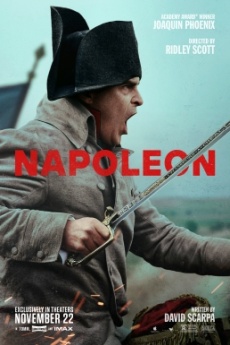
Comparison between the Theatrical Cut and the Director's Cut Different versions of Ridley Scott's NAPOLEONIn 2020, Ridley Scott was 82 years old and just in time for the completion of his elaborate filming of The Last Duel, he announced his next mammoth project, which was still called Kitbag at the time. In between, however, he quickly completed House of Gucci and in 2023 shooting wrapped on Napoleon. An impressive workload at an advanced age. Joaquin Phoenix took on the title role and, alongside Vanessa Kirby as Empress Joséphine at his side, there are of course some familiar faces in the supporting roles.  Originally planned with 20th Century Fox, Apple Studios ultimately took over production. The R-rating eased censorship fears regarding battle/sex scenes and a deal with Sony/Columbia saw the film released in cinemas at the end of 2023, before Apple TV+ and other providers added it to their VOD offerings from March 2024. What was exciting, of course, was that Scott announced shortly before the theatrical release, which had a running time of 158 minutes, that he also had a significantly longer, over 4-hour cut up his sleeve. So it's possible that compromises had to be made for the theatrical release - fans will certainly remember Scott's earlier epic Kingdom of Heaven, which not only runs a net 45 minutes longer in the Director's Cut, but has also been severely recut (see our detailed report).
The differences in the Director's Cut on Apple TV+A few moments from the battlefield have been added, but expectations should be lowered immediately. As Scott himself commented in an interview, he only wanted to use the half-minute shots of the Battle of Marengo to briefly delve into how many more campaigns and wars the ruler waged - but the focus of his film is clearly on a character study of Napoleon and his relationship with Joséphine.  In general, the historical framework and background are given more space, mainly through some strategic discussions between the various stages of Napoleon's career on the battlefield. In this context, the failed campaign in Russia deserves special mention. Tsar Alexander I has more screen time and it is hinted in several scenes that Napoleon was particularly plagued by intestinal problems during this time. It also becomes clearer how he repeatedly decided against the recommendations of his advisors. We see his men succumbing to the cold en masse and Napoleon himself making off in a devastating fire - including critical words from his companion, Armand de Caulaincourt, portrayed by Ben Miles. Afterwards, there are also several small additional dialog scenes in which Napoleon's complexes and his overconfidence and dissatisfaction come out. In contrast to Kingdom of Heaven, these are exclusively longer extensions. In both cases, however, one can clearly conclude that the film simply feels way more complete and that the Director's Cut (despite a running time that demands a lot of patience and the rather dialog-heavy style) is the version to be preferred. The theatrical cut's scene transitions are often far too abrupt and episodic, much remains fragmentary and thus loses a lot of its impact. Finally, it is interesting to note that Scott was also asked about his previously mentioned 4-hour version in the aforementioned interview on the release of the 205-minute version. He confirmed that this also exists, just not yet color-corrected and fully mixed. But theoretically a third version would be possible at some point - let's wait and see. Running times are arranged according to the scheme Theatrical cut VOD in 23.976fps / Director's Cut VOD in 23.976fps
The theatrical cut still has a Columbia logo at the beginning.
24 sec
16:20 / 15:56-21:50 After Napoleon has retrieved the bullet from the corpse, there is an additional scene in Paris in which a little girl (Joséphine's daughter Hortense) is questioned by an agent while Joséphine watches from the top of the stairs. It becomes clear how much pressure the family is under. Agent: “You know your father's under arrest?” Hortense: “He's a prisoner.” Agent: “Hmm. Do you know why?” Hortense: “'Cause he's a noble.” Agent: “Hmm. Are you a noble?” Joséphine: “Hortense, it's al-- it's all right.” Agent: “Hmm? Are you a noble?” Hortense: “Yes.” Agent: “Yes? Hmm. What do your parents say about royalty? Come now. Don't be shy. What do they say when they speak of Louis and Marie Antoinette?” Hortense: “My father is for the revolution. So am I.” Agent: “Don't lie to me or I will hurt you.” Joséphine: “Sir, she is five years old. She's not lying. My husband fought on your side.”
Then it's off to prison: Joséphine meets her friend Thérésia and we get a glimpse of the harsh everyday life. Warden: “Hands. Show me your hands. Mouth. Open your mouth. Open your mouth! Look at those teeth. That way.” Thérésia: “Joséphine.” They greet each other warmly. A man grabs Thérésia by the arm. Thérésia: “Hey, stop it.” Prisoners are driven out. Theresa: “The tombereau comes every morning. We have a rule. No tears. No goodbyes. We just wave like we're off to the café. Follow me.”
The two of them go up to the room and Thérésia makes it clear that pregnancy is a way out of death by guillotine. She strives for this and advises Joséphine to do the same. Thérésia: “A pregnant woman gets a stay of execution until the baby's born. And men never need a reason to fuck, do they?” They have arrived at the bed; “Welcome home.” With a slight change of scene, Joséphine looks at her hair in the mirror; “They say the blade of the guillotine can get caught in your hair.” Joséphine: “Got stuck in the king's neck.” Thérésia: “His neck was fat. You have the neck of a swan. You won't feel a thing. I'm not going to die. I'll do what it takes. And if that means getting pregnant, so be it. You can die like a lady, or you can live. Like me.” She has pulled a small noose around her neck; “This is the mark of a blade. Look.” Josephine then cuts off her hair and goes downstairs to a man.
We continue with a mass execution in the market square. Nuns pray on the way to the guillotine, but are also executed to the cheers of the crowd.
a total of 353.9 sec (= 5:54 min) 18:19 / 23:49-24:15 Before the imprisoned people free themselves, we see another man being led to the guillotine and beheaded. He is somewhat more resilient than the nuns, but of course cannot escape his fate either. 26.6 sec
19:26 / 25:22-29:18 Joséphine walks through the streets for a while and passes a painted French flag. Her apartment, seen in the previous additional scene, has been vandalized and she slowly makes her way upstairs. There she meets her former housekeeper Lucille, who then calls out the children she has been hiding and Joséphine immediately takes them joyfully into her arms. Joséphine: “Hortense? Eugène? Lucille?” Lucille: “Madame? Children, come.”
A conversation follows between Napoleon and a companion amidst the general mob. They are excited by the sexual charms. Companion: “Look at that. Look at that. Leaves nothing to the imagination. But then, I don't have much imagination. You know who they are? The new queens of Paris.” They stand up; “Yeah, let's go.”
A fade-in of “The Survivor's Ball” then introduces Napoleon meeting Paul again at a wild party. Paul grins at him from a corner. We see naked women playing music.
a total of 235.9 sec (= 3:56 min) The insert “The Survivor's Ball” also appears shortly afterwards (only) in the theatrical version.
22:29 / 32:21-33:37 Napoleon's encounter with Joséphine is followed by a sex scene between her and Paul. She demands a little more money, he pays and says she should get to know Napoleon better. When she asks why, he just holds out the bundle of money to her again. Together with the gambling debts mentioned at the beginning, the circumstances under which Joséphine approached Napoleon become even clearer. Paul: “You ran up a debt at cards tonight. I'll pay it this time.” Joséphine: “I've made your reputation in the salons, Paul. I should really ask for more.” Paul: “More? This will keep you afloat for now. But you should get to know Bonaparte better.” Joséphine: “Why?” Paul: “Because.” 76 sec (= 1:16 min)
26:47 / 37:55-38:48 Before Napoleon sits at the table with Joséphine, he is seen arriving in the streets near her house. The housekeeper takes a deep breath and then lets him in. 52.6 sec
30:46 / 42:47-43:25 Before the wedding, we see a meeting between Napoleon and Paul. They toast the 'savior of the republic', to which Napoleon comments dryly: “I'm just a watchman for our laws. For our Republic. For the universe. Nothing more. Liberty or death.” Another toast is raised to the last statement. 38.5 sec
31:48 / 44:27-45:37 An additional small segment, which also briefly covers the conquest of Italy with two shots of Napoleon riding through the crowd. Napoleon comes strutting in with a horse and we can still hear negotiations; “As part of the Peace Treaty, these masterpieces will be placed under the care of your archbishops. These works now belong to the people of France.” 69.6 sec (= 1:10 min)
32:59 / 46:48-47:58 Before the pharaoh scene, Napoleon and Joséphine are seen in bed together. She is unhappy that he is always away since they have been married. Napoleon promises that he will always come back to her. Joséphine: “Is this what will happen from now on? I marry you and you leave? Every time you leave, I have no assurance of your return.” Napoleon: “My sweet Joséphine. The only thing you can depend on in this world, is that I shall always return to you.” 70.1 sec (= 1:10 min)
|